Overview
Installation
Users Guide
Support
Overview
haneWIN TFTP Server for Windows is a fully-realized TFTP server for all Windows Versions. The TFTP Server runs as a background service and doesn't require permanent attendance. It has been designed to work reliable and secure in background operation mode using a high-performance multithreaded architecture.
The software is implemented in 32- and 64-bit versions.
The software provides a TFTP Server (as application and as NT service)
and TFTP client based on RFCs 1350, 2347-2349 and TFTP mulicast based on RFC 2090.
All TFTP options are supported.
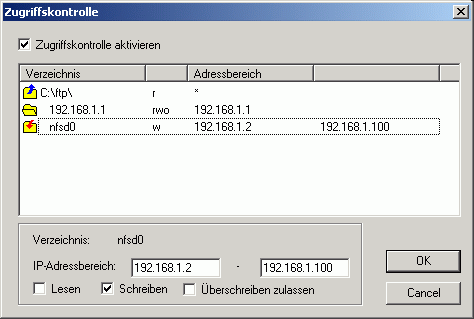
Access control is provided per directory for client IP address and type of
operation.
A native TFTP service is implemented for Windows 200x/XP/Vista/7/8/10.
A Control Panel applet gives interactive access to the service.
Installation
- Requirements
-
Windows 200x/XP/Vista/7/8/10 system configured for TCP/IP
- Installation of the TFTP service on Windows 200x/XP/Vista/7
-
- Install the software by running the setup.
- Use Install TFTP service from the start menu to install the server as service.
- With the control panel applet TFTP Server you can configure and monitor the service.
- Preparation of TFTP Server Application
- Extract the zip-archive, start the application.
Users Guide
The Info Box at startup is displayed only for the unregistered version.
The main windows of the TFTP server displays the status of all active client connections (addresses, progress and type of operation, accessed file).
Running the TFTP server as a Service on Windows 200x/XP/Vista/7
The server can be installed as a service on Windows 200x/XP/Vista/7 for background operation. The service can be configured and monitored by the Control Panel Applet TFTP Server.
- The Service is installed with the command:
TFTP4NT -install
and automatically started on Windows startup. The service can be started and stopped manually through the service control panel. - Use the command
TFTP4NT -remove
to stop and remove the TFTP server service.
- Menus
- File
- Start
- if selected the server accepts new connections.
- Stop
- if selected new connection requests to the server are inhibited. Active connections are not affected.
- View log
- displays a log of all TFTP client requests.
- Exit
- terminates the program
- Options
- Preferences
-
for changing configuration settings.
General
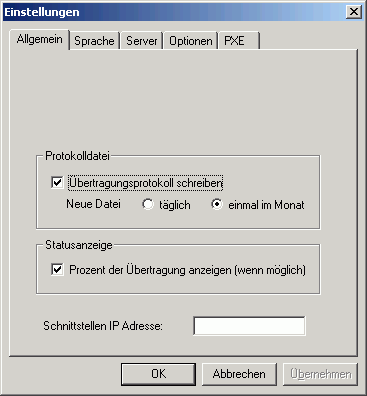
By default the Server is started on all local interfaces. You can restrict the server to one interface only by specifying the local interface IP address.Server
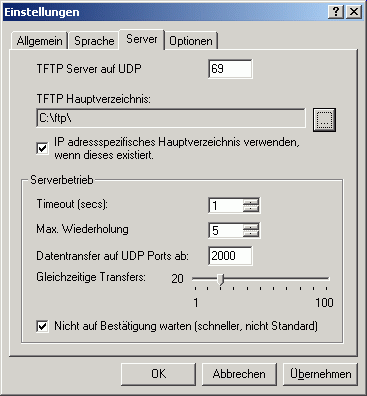
A server root directory must be defined. Any client access outside of the root directory tree is denied. An option enables the server to use a subdirectory of the root directory as a client specific root directory. If this option is enabled and a subdirectory with the IP address of the client exsists, it will be used as the root directory for the client.
The sever allows indicating the range of UDP ports, used for transmitting the data. This allows network administrators to regulate firewall rules, approving the traffic, generated by the server. The UDP port range is defined by specifying the first UDP data port and the number of active clients.Options
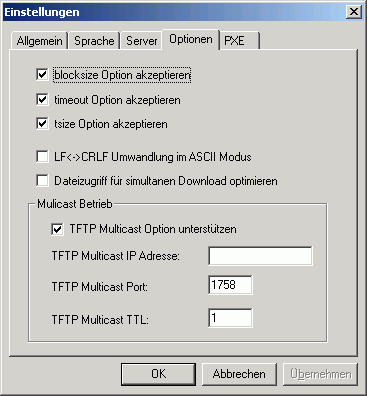
As part of a request TFTP clients can send options to the server. The server can accept or reject the options.- The blocksize option allows the client to choose a data packet size greater than 512 bytes.
- The timeout option allows the client to choose the timeout value for retransmissions. Otherwise the timeout value set on the server will be used.
- With the tsize option the client can inform the server about the total size of the transfered data.
With TFTP Multicast clients can download a file simultanously. The file is sent by the server to the specified multicast address and port. If more than one multicast transfer is started the multicast port number is incremented.PXE
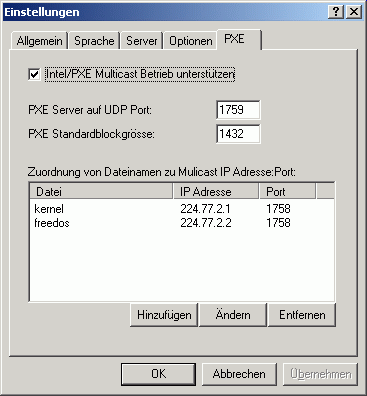
The Intel/PXE specification uses a different protocol for multicast operation. Multicast configuration parameters are sent to clients using DHCP options.- Multicast requests are directed from a client to an extra server port.
- The default blocksize is 1432 bytes.
- Each file downloaded using multicast operation is send to an unique multicast IP address and port.
- Access control
-
Supermodels From 7 17 Updated Direct
The year 2007 represented a massive transition in the modeling world. High fashion shifted from the athletic Brazilian wave to an ethereal, doll-faced aesthetic, while the commercial world was dominated by the peak era of the Victoria's Secret Fashion Show.
During the early part of this decade, established icons from the late 90s continued to dominate both the runway and commercial contracts. Gisele Bündchen
Post-2017, Campbell experienced a profound personal and professional renaissance. She welcomed two children, became a contributing editor for British Vogue, and was awarded the Fashion Icon Award by the CFDA. She continues to close major shows for Versace and Balmain, proving her timeless relevance. Gisele Bündchen: The Eco-Mogul's Return
: Crowned the Supermodel International 2025 winner from the Dominican Republic. Alex Consani Angelina Kendall : Cited by RUSSH supermodels from 7 17 updated
July 2017 marked a structural turning point in fashion history. The industry was actively transitioning away from the traditional, insular agency models toward an ecosystem driven by digital presence, body inclusivity, and entrepreneurial autonomy. The models dominating the scene during this period were no longer just hangers for haute couture; they became multimedia moguls, activists, and global brand architects. 2. Profile Updates: The Vanguard of Modern Fashion Naomi Campbell: The Reigning Matriarch
: A powerhouse of the 2017 era (notably for Tommy Hilfiger ), she remains a central figure in high fashion while expanding into business. Bella Hadid
Let's search for "supermodels from 7" maybe.. The year 2007 represented a massive transition in
Both sisters completely silenced critics by developing distinct, high-fashion identities. Gigi transitioned into design and television hosting, launching her luxury knitwear line, Guest in Residence. Bella became the ultimate muse for avant-garde designers, culminating in her viral, spray-on Coperni dress moment, which was widely heralded as a historic milestone in fashion technology. 3. The Shift in Industry Metrics
A current social-media-driven runway breaker
If you had asked in 2017, the answer was Kendall or Gigi. As of 2024, the crown belongs to . Gisele Bündchen: The Eco-Mogul's Return : Crowned the
As of the latest update (July 17, 2025—assuming future cycles), the supermodels born on this day and those featured in its archived issues continue to dominate. Their faces have been scanned, their walks have been remastered, and their stories have been corrected. That is the power of —the day fashion pauses to digitize, restore, and celebrate the women who made the runway a religion.
The newest generation of supermodels isn't just about fame; it's about pure runway dominance. Bhavitha Mandava is a perfect example. Discovered on a Brooklyn subway, this NYU graduate became a muse for Chanel and Bottega Veneta, and opened the prestigious Chanel Métiers d’Art 2026 show. Her rapid rise signals a return to valuing raw talent and a powerful presence on the catwalk.
Bündchen had officially retired from constant runway walking in 2015, focusing on high-profile print campaigns and her environmental activism.
The fashion landscape is undergoing its most radical transformation since the 1990s. The traditional definition of a supermodel has expanded far beyond the exclusive boundaries of the "Big Six". Today, the industry embraces a dynamic spectrum of faces, tracking exceptional talent from early development at .
To help you properly, could you clarify what “7 17” refers to? For example:
- Help
- Contents
- starts a HTML browser displaying the manual.
- Register
- prompts for the license key and your name, company. Check the Info menu to find out if the license information was accepted.
- Show License
- displays the conditions for using this software.
- About...
- displays program version information.
Using the TFTP Client
TFTP.EXE is a Win32 command line TFTP client.The implementation of the client as a command line program allows easy use of the client for automated tftp data transfer from application or procedures.
Usage: tftp [Options] server GET|PUT file [local]
- server: IP address or name of the TFTP server
- file: Name of file to transfer
- local: Local name of file
- Options:
- -a mode ASCII, default OCTET
- -b<blocksize> block size in bytes, default 512
- -d write debug messages
- -l show transfer activity
- -o override if local file exists
- -p pipe: send data from stdin/receive data to stdout
- -r<retries> number of retries on timeout
- -s disable transfer size option, default enabled
- -t<timeout> retransmission timeout in seconds, default 1s